A decade teaching JEE Chemistry. These days I build the AI tools I always wished my students had — and I love getting them into people's hands. 15+ deployed products so far. This page shares what I've built, and a little of how I think while building it.
The classroom was my first product team. Ten years at Aakash, FIITJEE, and Amazon Academy — plus two institutes I built from scratch — taught me to notice the exact moment a learner gets stuck, and to find the smallest thing that helps them through it.
That habit turned out to be product management. So I started building the tools I wished my students had: RAG doubt-solvers, answer-grading pipelines, voice trainers, GTM agents — on a real stack, used by real students. I enjoy taking an idea all the way to something people can actually use.
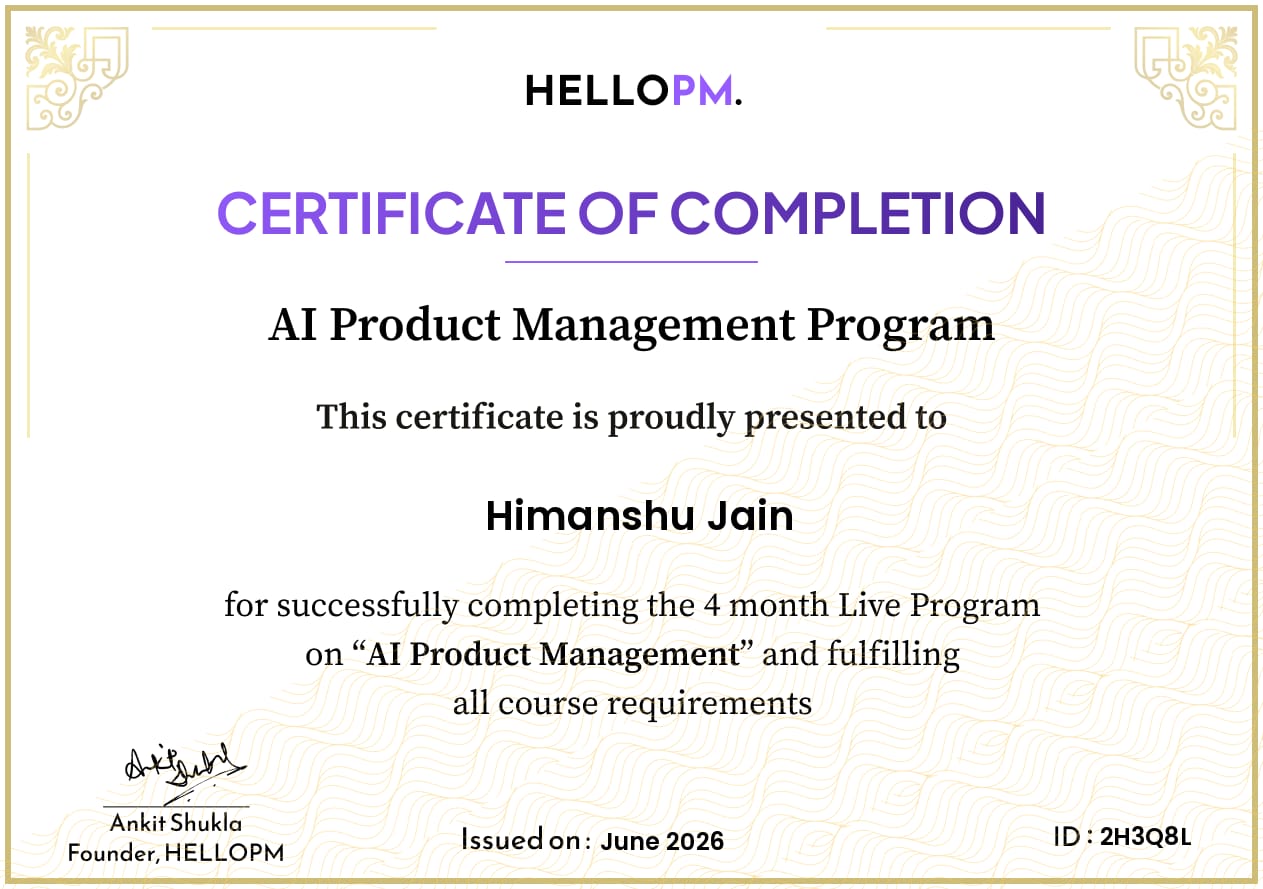
Today I'm finishing HelloPM's AI Product Management program. The teacher-to-builder path has been a natural one for me — and I'm grateful for where it's led.
Most portfolios show what someone built. I'd also like to share how I think while building. So here's ChemIQ — the product I've put the most into — laid out the way I'd walk a student through a reaction on the board: one step leading into the next, including the step that didn't work at first.
Students stuck on Chemistry at 11pm. No teacher awake, generic chatbots hallucinate, textbooks don't answer this doubt. I watched it for a decade.
JEE answers must cite the syllabus, not the internet. The doubt is often a photo of messy handwriting on a dark slide. Retrieval + vision, not a wrapper.
Hybrid BM25 + vector retrieval over my own notes, a Groq vision model to read handwritten slides, and a multi-stage grading pipeline — answers are sourced, not guessed.
Pure vector search returned plausible-but-wrong passages on lookalike reactions. Latency spiked on long PDFs. Both surfaced only once real students used it.
Evals aren't a finishing step — they're the product. RAG failure analysis now lives in the PRD before I write a line. Domain depth is the moat, not the model.
Not just a grid. Columns are clusters (where I build), rows are maturity (shipped → in progress → concept). You can read my whole product strategy in one glance.
A full teardown of redBus: mapping every flow and friction point, reverse-engineering key features, segmenting users, and prioritising problem hypotheses — backed by real screenshots and wireframes.
A complete PRD written to program spec — problem framing, goals, user stories, scope, and success metrics for a defined product build.
The product requirements for ChemIQ's retrieval-augmented generation system: grounding a JEE-Chemistry assistant in real lecture notes, with retrieval design and evaluation baked in.
An exploration of how professionals move from experimenting with AI to depending on it — and what that shift means for building tools people actually adopt.
An agentic day-planning concept built for the Indian context: turning intent into a structured, realistic daily plan. Presented as a full product deck.
A recruiter, a founder, a fellow builder — ask anything about what I've built, my stack, or the teacher-to-PM story. It answers from my actual portfolio.